




After taking a big swing with the blockbuster acquisition of Dejan Joveljić last week, the Seattle Sounders had one more move in store before the close of the MLS summer transfer window.
Niko Moreno first reported and Tom Bogert subsequently confirmed Wednesday that Seattle finalized a trade to acquire 23-year-old attacking midfielder Caden Clark from D.C. United.
In exchange, Seattle will send D.C. a second-round pick in the 2028 MLS SuperDraft while taking on Clark’s current contract, which runs through the end of 2026 with a club option for 2027.
What should we make of the move? Let’s make the case for and against the Sounders’ latest addition before weighing both sides and delivering a final verdict.
| ||||||
| ||||||
| ||||||
|



The case for: Low-stakes, high-reward
There's nothing wrong with taking a flyer.
In fact, there’s an argument that every MLS team should have a couple of them on the roster at any given time. Not every reclamation project is going to hit, but if you can find low-stakes acquisition costs like this, there’s plenty of value to be found by betting on talented players whose careers have stalled for one reason or another.
And I'll say this much: Whatever you think of how Clark’s career has unfolded, his status as such a highly touted prospect definitely didn’t come from nowhere. There was a time when this was legitimately one of the biggest young names in MLS.
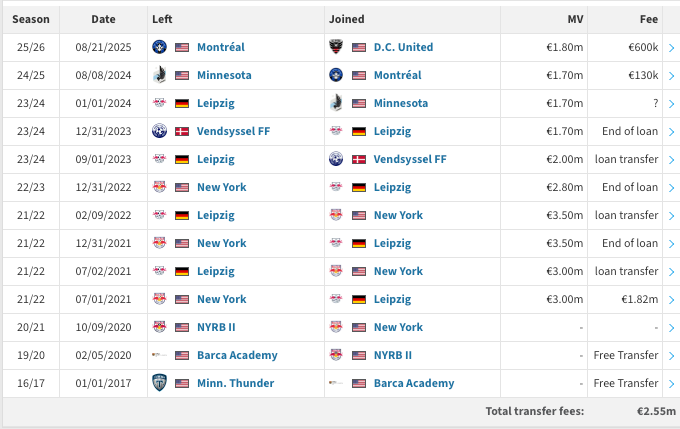
After breaking through with the New York Red Bulls as a 17-year-old in 2020, Clark was a darling of the scouting, pundit and USMNT bot classes, eventually earning a transfer to Bundesliga powerhouse RB Leipzig and finishing No. 8 on MLS’s 22 Under 22 list in 2021.
You could certainly argue his career since then is an example of why everyone should probably pump the brakes before anointing prospects like this too early. But being overhyped as a prospect doesn’t mean the underlying talent that generated that hype never existed. Clark showed plenty of it during his initial Red Bulls breakthrough, posting 4g/3a in 1,502 MLS minutes in 2021. And while his career never really took off, there have been more recent flashes as well.
The best example came after a midseason trade to CF Montréal in 2024. Clark went for 4g/2a in just 733 regular-season minutes, helping Montréal reach the playoffs. He followed that up with four more assists across 26 league appearances for Montréal in 2025 before moving to D.C. United.
That does provide tangible evidence that, when he’s playing consistently and in the right situation, there’s a productive player in there.
His skill set is intriguing for Seattle, too. At his best, Clark has shown the ability to create danger off the dribble, attack defenders from wide areas and generate chances in ways the Sounders have often lacked from their attacking midfielders this season.
That need has only become more pronounced with Pedro de la Vega likely lost for the season due to his latest injury. De la Vega was Seattle’s most obvious one-on-one threat, capable of receiving the ball out wide, beating a defender and creating something that wasn’t necessarily manufactured by the structure of the offense.
Jesús Ferreira’s hamstring injury has further depleted the position group. Ferreira isn’t the same type of player as de la Vega, operating more as a pocket winger/dual 10, but his absence still leaves Seattle down another important attacking body for potentially the rest of the regular season.
That has left 20-year-old Sebastian Gomez as arguably the only healthy player on the roster who consistently offers that direct, take-on-a-defender skill set from wide areas. Gomez has flashed plenty of upside since breaking into the first team, but asking such an inexperienced player to be the lone source of that element in the attack is just not ideal.
Clark gives Seattle another player who, at least theoretically, can provide some of it. That doesn’t mean he’ll necessarily do so consistently, but given the current construction of the roster, and particularly the injury situation, it makes a flyer here plenty defensible.
The case against: The squint and extrapolate fallacy
Of course, there’s a reason a player with Clark’s pedigree is available for a 2028 second-round SuperDraft pick.
For starters, we know he wasn’t necessarily Seattle’s first choice. Sounder at Heart reported that the Sounders were working on a deal for another player before said player asked for roughly double the salary figure Seattle had initially discussed, causing the move to fall apart. Clark therefore appears to be something of a fallback option.
Clark's career has also stalled out pretty demonstrably. The early breakthrough with the Red Bulls led to a high-profile move to RB Leipzig, but Clark never made a competitive first-team appearance for the Bundesliga club. Since returning to MLS, a combination of injuries, inconsistent availability and competition for minutes has repeatedly prevented him from establishing himself as anything more than a depth piece.
Even some of the production we highlighted in the previous section comes with an obvious caveat: We have a classic case here of having to squint and extrapolate.
You can look at Clark’s production over 1,500 minutes in one season or 700-something in another and convince yourself there’s a highly productive MLS attacker waiting to emerge if you simply stretch those numbers across 2,500 minutes. We’ve certainly done plenty of squinting and extrapolating around here before. I'm a notorious squinter and extrapolator.
But one lesson worth taking from the Danny Musovski experience is that when you find yourself looking at a stat page while both squinting and extrapolating, there’s usually a reason you have to do that.
That’s been the recurring issue throughout Clark’s career. The intriguing flashes have been there. What hasn’t been there is a sustained stretch where he’s stayed healthy, won a starting job and turned those flashes into consistent production over a full season. It’s easy to become enamored with what he represented as a prospect, but Seattle isn’t acquiring 17-year-old Caden Clark. They’re acquiring the 23-year-old version whose career has yet to deliver on that promise.
His most recent stop is particularly difficult to spin. Clark has played just 82 MLS minutes across seven appearances for D.C. United this season and hasn’t appeared in league play since April. Injuries have played some role in his availability, including a recent head injury, but that doesn’t explain the full picture. Clark spent a significant stretch healthy enough to make D.C.’s matchday squad without actually getting on the field.
There’s also a broader trajectory to acknowledge: Clark went from one of the most highly regarded American prospects in MLS, to a move to Leipzig that never materialized into first-team minutes, to trying to reestablish himself back in MLS, to now being moved again for a minimal return.
At some point, what a player was projected to become by the scout and pundit class matters a lot less than what he's actually been on the field.
The verdict
The biggest concern with this move isn’t Clark himself, or the idea of a dart-throw. It’s the role Seattle seemingly needs him to fill.
There’s nothing wrong with taking a flyer, particularly when the acquisition cost is as negligible as a second-round SuperDraft pick three years from now. If Seattle already had reliable cover on the wing and Clark was simply a supplementary dart throw on a talented 23-year-old with some intriguing upside, I would endorse this move without much hesitation.
But that’s not really the situation.
If Seattle was pursuing a more significant addition at the position before that deal fell apart, that suggests the Sounders themselves viewed this as a legitimate, pressing need.
There’s a difference between taking a flyer to supplement an already-solid position group and taking a flyer to address a hole where you actually need someone capable of providing impactful minutes. If you're in the latter situation, you really need the flyer to hit, which is never ideal.
Maybe Clark does hit. He's still only 23, possesses traits Seattle needs and costs next to nothing to acquire. But given the current state of Seattle's depth at the position, there's considerably more riding on this gamble than you want.

Discussion