




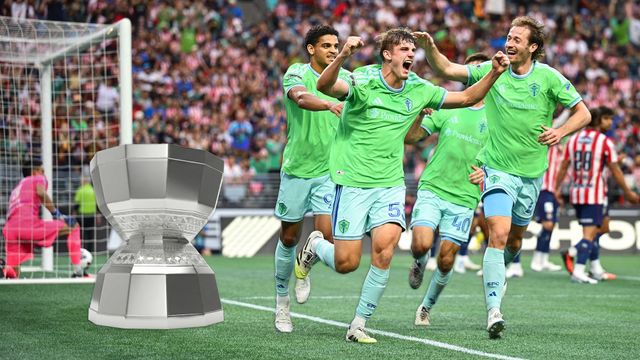
Coming off the Seattle Sounders’ much-needed win over Querétaro in Leagues Cup Phase One, we played a round of Cope or Hope on Monday’s Lobbing Scorchers Kickoff (presented by QED Coffee) to assess which encouraging signs from the performance might actually be sustainable.
The bigger question is how much of what we saw represented actual solutions for a team trying to turn its season around, and how much was simply the product of playing an overmatched opponent.
Here’s where we landed.
Alex Roldan at the No. 6
For weeks, the Sounders’ midfield looked like a problem without an obvious solution.
With Cristian Roldan sidelined, Seattle cycled through different combinations in the double pivot, trying players like Snyder Brunell, Hassani Dotson and Peter Kingston without ever really finding a like-for-like replacement. The results were predictable and not good: The Sounders struggled to control games, turnovers became increasingly costly, and Albert Rusnák and Jesus Ferreira were often forced to drop deeper to get involved, which contributed to the whole operation being disjointed and ineffective.
So, naturally, the solution was a simple one that the Sounders have employed to great effect over the years: Just put a Roldan on it.
It's a longtime organizational philosophy, and it's basically what Brian Schmetzer did against Querétaro, moving Alex Roldan into the double pivot beside Kingston. And while one game isn’t enough to declare the midfield fixed, the early returns at least offer something to build on.
Seattle looked more composed in possession and had considerably more control through the middle of the field. There were still giveaways and moments a better opponent might have punished, but the overall structure looked much closer to functional, which is where the bar for improvement is at right now. Rusnák was able to operate in more dangerous areas, and the Sounders finally looked capable of progressing the ball through midfield without every possession feeling like an adventure. Even Kingston seemed to gain confidence from having a Roldan next to him, hitting a couple of truly impressive through balls, including one that helped set up Danny Musovski's goal.
Alex isn’t Cristian, and this shouldn’t suddenly eliminate the need for reinforcements at the position. But if the Sounders have stumbled into a viable short-term answer while Cristian works his way back, that could go a long way toward stabilizing a midfield that has been at the center of their recent struggles.
Verdict: HOPE
Albert Rusnák back in his natural role
If Alex Roldan’s move into the midfield offered some hope for the Sounders, the knock-on effect it had on Albert Rusnák was also pretty evident.
One of our running theories during Seattle’s losing streak was that the dysfunction in the double pivot was dragging Rusnák, and really the entire front-four, down with it. Instead of consistently receiving the ball in advanced areas, he was dropping deeper and deeper to help Seattle progress the ball, leaving the Sounders without one of their most important attacking players where he’s actually most effective.
Against Querétaro, the whole thing looked considerably more functional. Rusnák helped create the sequence that led to Seattle’s opening goal and scored one himself in the second half, while generally looking much more like the player we’re accustomed to seeing when the Sounders are playing well.
Yes, it came against a bad team. The haters will say it doesn’t count. But the performance at least offered evidence for the theory: If Seattle can control games through the midfield and allow Rusnák to actually play as a No. 10, the attack has a much better chance of functioning. There’s reason to believe that can translate against better opposition, even if it won’t look quite as easy.
The bigger question is what the ceiling of that formula actually is, particularly with Pedro de la Vega injured again. Rusnák has taken plenty of criticism during Seattle’s downturn, and it’s still fair to wonder whether he can carry enough of the attacking load for this team to legitimately contend for trophies.
Sunday didn’t answer that question. But it did offer some hope that getting Rusnák back to do what he does best can make this offense look considerably better.
Verdict: HOPE — with some reservations
Danny Musovski’s goal opens the floodgates
It was undoubtedly good to see Danny Musovski finally get one.
Moose scored his first goal in a while against Querétaro, and perhaps just as importantly, it came from the type of opportunity the Sounders simply haven’t been consistently generating for him. Paul Rothrock found him in the box, Moose got a legitimate look on goal and finished it. Remarkably, it was the first goal a starting No. 9 has scored for Seattle all season.
That illustrates some of what we’ve been talking about with Moose during his struggles. He’s a striker who is highly dependent on the ecosystem around him. He needs Seattle to control games, progress the ball into dangerous areas, and consistently create chances for him inside the penalty box. With De la Vega injured and the midfield descending into chaos during the losing streak, those opportunities have been few and far between.
So there’s an argument that a more functional Sounders team can get considerably more out of Moose than we’ve seen so far, like we saw last year, when he erupted out of nowhere for 18 goals.
But does one goal mean the floodgates are about to open and Seattle’s issues at No. 9 are suddenly solved? That’s much harder to buy.
Moose can benefit from a better environment, but there’s still little reason to expect him to suddenly become the type of difference-making line-leader who can elevate an attack when everything around him isn’t working. Until Seattle fixes that ecosystem — and starts consistently supplying the strikers with quality chances again — one encouraging finish isn’t enough to declare the problem solved. Getting that line-leader still needs to be near the top of the priority list for this front office.
Verdict: COPE
Sebastián Gómez as Seattle’s next attacking prospect
Sebastián Gómez provided one of the more genuinely fun young-player performances we’ve seen from the Sounders in a while.
The 20-year-old finished with 1g/1a against Querétaro, making an excellent back-post run to score the opener before showing impressive awareness and maturity on his assist to Rusnák. Rather than forcing the issue himself, Gómez recognized the better opportunity, left the ball for Rusnák and helped create Seattle’s third goal.
Beyond the production, there was something refreshing about simply having a new curveball thrown into the mix.
The Sounders have felt stale at times over the last couple of seasons, and Gómez represents the possibility of some legitimately untapped upside. Seattle’s academy has produced plenty of quality midfielders over the years, but the track record of developing impactful attacking players is considerably thinner, with Jordan Morris standing as the obvious success story.
Especially if significant outside reinforcements aren't coming, developing an attacker who can become a legitimate contributor would be a massive win.
That doesn’t mean Gómez should suddenly be expected to fill Pedro de la Vega’s role. Asking a 20-year-old with limited first-team experience to replace one of Seattle’s most important attacking players this season would be putting far too much on one encouraging performance.
But as a longer-term proposition? Gómez gave us a glimpse of an attacking prospect who might have considerably more to offer.
Verdict: HOPE — just don’t make him the PDLV replacement yet
Paul Rothrock getting back to creating
Paul Rothrock has spent much of this season carrying a goal-scoring burden the Sounders probably never intended him to have.
And while he’s handled that responsibility admirably, it has arguably come at the expense of one of his best qualities: creating chances from wide areas.
Against Querétaro, we finally got to see more of that version of Rothrock. With the midfield more settled, the offense functioning better and Gómez making the types of runs you’d expect from a more traditional winger, Rothrock was able to find space to provide service rather than constantly being asked to manufacture the end product himself.
The result was two primary assists, including an excellent ball to the back post for Gómez’s opening goal.
As the Sounders try to figure out what their attack can look like without Pedro de la Vega, getting that version of Rothrock back can only help. He’s already established himself as one of Seattle’s most reliable attackers; adding more consistent chance creation back into the equation gives them another way to generate offense without their most dynamic attacking player.
But there’s a difference between believing Rothrock can help compensate for De la Vega’s absence and believing he can replace what a healthy DP-level difference-maker provides when the stakes get highest.
We talk all the time about the importance of having your needle-moving DPs available when trophies are decided. Nicolás Lodeiro and Raúl Ruidíaz did that for years, and De la Vega showed during the 2025 Leagues Cup what it looks like when that type of player takes over a tournament.
As good as Rothrock has become, asking him to carry that same burden through an MLS Cup run is probably asking too much.
There’s hope that a more functional offense can unlock one of Rothrock’s best qualities again. There’s considerably less reason to believe that alone makes Seattle equipped for a deep playoff run without De la Vega.
Verdict: HOPE on Rothrock the creator; COPE on replacing PDLV


Discussion